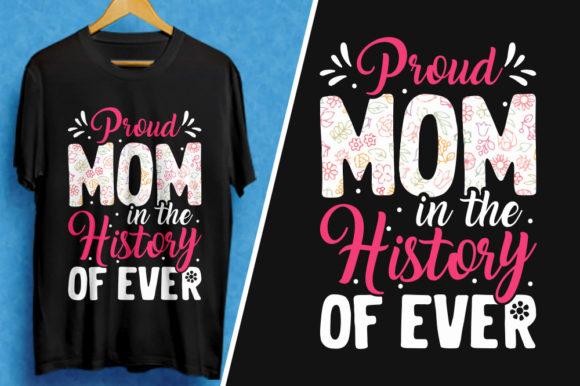
Reviewing the Proud Mom in the History of Ever T-Shirt Design
As a designer who spends more time staring at stitch simulations than actual fabric, I have learned that not every T-Shirt Designs concept translates well to the needle. We often see digital Graphics that look stunning on a screen but turn into a tangled mess under the presser foot. Recently, I evaluated the Proud Mom in the History of Ever T-Shirt design to determine its viability for real-world embroidery projects. This is not just a Mother’s Day slogan; it is a statement piece that requires careful handling to ensure the final product meets professional standards.
First Impressions and Visual Personality
The phrase "Proud Mom In The History Of Ever" carries a bold, humorous, and affectionate tone. It appeals to the modern mother who embraces her role with pride and a sense of humor. Visually, the design relies heavily on typography. When reviewing the provided files—specifically the high-resolution PNG (4500×5400 at 300 dpi) and the editable EPS and AI vectors—the layout appears clean and centered. For an embroidery designer, this suggests a focus on legibility and impact rather than intricate pictorial details.
The mood created is celebratory yet grounded. It does not scream for attention with chaotic elements but stands firm with its message. This visual personality makes it naturally suited for apparel where the text is the hero. However, because it is text-heavy, the choice of font weight and spacing in the original vector files will dictate how well it stitches out. If the letters are too thin, they may disappear on textured fabrics; if too dense, they may cause puckering.
Real-World Application: The Custom Sweatshirt Scenario
To test the practicality of this design, I imagined a common client request: a custom Mother’s Day gift for a boutique customer. The client wanted a premium, heavyweight cotton sweatshirt. This is an ideal canvas for the Proud Mom in the History of Ever T-Shirt design. Sweatshirts provide enough stability to support the stitch density required for clear lettering without excessive stabilizer use.
In this scenario, the design would likely be placed on the chest or across the upper back. Using a satin stitch for smaller text elements and a fill stitch for larger letters would create a tactile, high-quality finish. The contrast between the thread colors and the fabric is crucial here. For a navy sweatshirt, using white or light gray thread ensures the message pops. For a heather gray shirt, a deep burgundy or navy thread adds sophistication. The result is a personalized gift that feels substantial and valuable, far exceeding the perceived value of a simple printed tee.
Versatility Across Product Lines
Beyond sweatshirts, this design has potential in various embroidery project categories. Consider a canvas tote bag design. The sturdy fabric of a tote can handle the density of the text, making it a practical and stylish accessory for moms on the go. Similarly, an embroidered patch featuring this quote could be sold as a standalone item, allowing customers to iron or sew it onto jackets, jeans, or backpacks. This versatility is key for Etsy seller strategies, where one design asset can be adapted into multiple small shop product listings.
However, caution is needed when applying this to smaller items like baby clothes. While baby embroidery is a lucrative niche, the length of the phrase "Proud Mom In The History Of Ever" might be too wide for a onesie chest. In such cases, scaling down the design could compromise legibility. It is better suited for larger surfaces like pillow covers or kitchen towels, where the text can breathe and remain readable.
Technical Challenges and Fabric Considerations
Working with text-based designs requires a keen eye for technical detail. The primary challenge with the Proud Mom in the History of Ever T-Shirt design is maintaining stitch clarity on difficult fabrics. On stretchy materials like jersey knits, improper stabilization can lead to distortion. The letters might warp, turning a professional custom apparel piece into a amateurish mistake. Using a cut-away stabilizer is often recommended for knits to provide long-term support.
Textured fabrics present another hurdle. If you are embroidering on a waffle-knit towel or a rough linen, fine details in the font may get lost in the weave. In these cases, increasing the stitch density slightly or choosing a thicker thread weight can help the design stand out. Conversely, on smooth, thin fabrics like silk or lightweight rayon, high-density stitching can cause puckering. A test run on scrap fabric is non-negotiable here. You must check how the stitch density interacts with the specific material before committing to the final finished product.
Dark fabrics require careful color selection. While white thread on black fabric is classic, it can sometimes look stark. Experimenting with off-whites, creams, or even metallic threads can add depth and luxury to the design. Always test your thread colors against the fabric under different lighting conditions to ensure the message remains clear and appealing.
Enhancing Brand Value and Customer Trust
For craft business owners, the quality of embroidery directly impacts brand perception. A well-executed Proud Mom in the History of Ever T-Shirt design signals professionalism. It shows that the maker understands tension, stabilization, and fabric behavior. This attention to detail builds customer trust and encourages repeat business. When a customer receives a handmade product that looks polished and durable, they are more likely to leave positive reviews and recommend your shop to others.
Moreover, this design fits well into seasonal marketing campaigns. As a holiday embroidery staple for Mother’s Day, it can be promoted weeks in advance. Creating printable mockup images that show the design on various products helps customers visualize the end result. These design assets are essential for online sales, where buyers cannot touch the product. High-quality previews can significantly boost conversion rates.
Practical Notes for the Embroidery Designer
Before launching this design into your production line, consider these practical steps:
- Test on Scrap Fabric: Always run a test stitch-out on the same type of fabric you plan to use for the final product. This reveals issues with tension, density, or registration.
- Check Hoop Size: Ensure your machine’s hoop size can accommodate the full width of the design. If the design is too large, you may need to split it or reduce the scale, which could affect readability.
- Review File Formats: The product includes PNG, EPS, and AI files. Note that these are graphic files, not native machine embroidery formats like PES or DST. You will need to digitize the design or convert it using embroidery software. Check the licensing terms to ensure you have the right to create and sell the embroidered items.
- Inspect Small Details: Look closely at the curves and corners of the letters in the vector file. Sharp corners may need to be rounded slightly in the digitizing process to prevent thread breaks.
- Contrast is Key: Use black and white mockups to check the contrast. If the design disappears in grayscale, it will likely lack impact in real life.
In conclusion, the Proud Mom in the History of Ever T-Shirt design offers a strong foundation for meaningful, marketable embroidery projects. Its success depends on thoughtful execution, appropriate fabric selection, and precise digitizing. By treating it with the respect it deserves, designers can create standout pieces that resonate with customers and elevate their brand.