Tough Enough to Be a Laborer: A Designer’s Review
As an embroidery designer who has spent years digitizing patterns and testing them on everything from stiff denim caps to delicate baby onesies, I approach every new machine embroidery design with a mix of excitement and skepticism. We have all been there: you download a file that looks crisp on the screen, only to find it puckers the fabric or loses its legibility once the needle hits the cloth. That is why I took a close look at the Tough Enough to Be a Laborer T-shirt design before committing it to a client project or adding it to my own shop inventory.
This piece falls under the category of Print Templates and Graphics, which immediately tells me that the source files are likely vector-based or high-resolution raster images intended for versatility. The product description highlights that you receive an EPS file compatible with Adobe Illustrator CS6 and an SVG file, both at A4 size and 300 dpi. For those of us in the craft business, this is a crucial starting point. It means we are not just getting a static JPEG; we are getting editable assets that can be adapted for various uses, including screen printing, heat transfers, and, with proper digitizing or conversion, embroidery.
First Impressions and Visual Personality
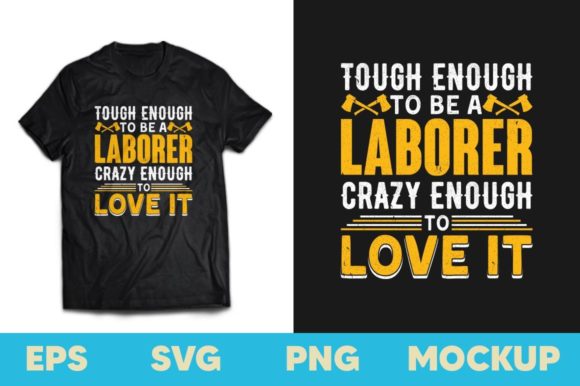
The phrase "Tough Enough to Be a Laborer, Crazy Enough to Love It" carries a specific mood. It is rugged, proud, and slightly humorous. Visually, this type of typography-driven design relies heavily on font weight and layout balance. When I first opened the files, I looked for clean lines and sufficient spacing between letters. In embroidery, tight kerning can lead to thread breaks or messy jump stitches if not handled correctly. The bold nature of the statement suggests it is meant to be seen from a distance, making it ideal for workwear, union gifts, or Labor Day celebrations.
The design does not appear to rely on intricate shading or photorealistic details, which is a relief. Complex gradients do not translate well to thread. Instead, the strength of this graphic lies in its message and its structural simplicity. This makes it a strong candidate for a fill stitch application on larger text elements, potentially accented with a satin stitch border to give it definition against textured fabrics.
Real-World Application: The Sweatshirt Test
To truly evaluate the Tough Enough to Be a Laborer T-shirt design, I imagined applying it to a heavy cotton blend sweatshirt. This is a common request for small shop products and Etsy sellers looking to create personalized gifts for fathers, construction workers, or tradespeople. On a sweatshirt, the fabric has enough loft to support dense stitching without showing the backing material too prominently.
If I were stitching this as a custom apparel item, I would pay close attention to the stitch density. Heavy lettering on a soft garment can cause stiffness. My advice would be to use a lighter fill pattern or incorporate some open spaces within the larger letters to allow the fabric to breathe. The result should be a professional-looking finished product that feels durable but not like a plastic patch glued to the chest. For a tote bag design, however, you could afford to go denser, as canvas materials handle heavy thread coverage much better.
Navigating Fabric and Hoop Constraints
One of the most critical aspects of using any digital embroidery file is understanding where it might fail. While this design is robust, it is not universal. If you are planning to use it on a curved surface like a cap, you must consider the hoop size and the distortion that occurs on structured fronts. The length of the phrase might require a larger hoop, such as a 5x7 or 6x10, depending on how you scale the text. Cramping it into a 4x4 hoop would likely render the smaller words illegible.
Furthermore, be cautious with thin or stretchy fabrics. A design with this much textual content requires a stable foundation. Without a proper stabilizer—likely a cut-away for knit shirts or a tear-away for woven cottons—the fabric will pucker around the letters. I always recommend testing the design on scrap fabric first. Check how the thread colors contrast against the background. A dark thread on a dark shirt will vanish, while a bright color on a neon safety vest might clash. Always view your mockups in black and white to ensure the contrast holds up regardless of hue.
Commercial Viability for Makers
For Etsy sellers and creative entrepreneurs, the value of this asset lies in its adaptability. Since the package includes EPS and SVG files, you are not limited to embroidery. You can use these design assets for creating printable mockup previews for your online store, even if you are selling the physical embroidered item. This helps customers visualize the handmade product before purchasing.
However, a note of caution regarding licensing: the product description mentions it is a "Labor Day T-shirt Design" and provides graphic files. It does not explicitly state that the files are pre-digitized embroidery formats (such as PES, DST, or JEF). As a professional, I must clarify that EPS and SVG are vector graphics. To embroider this, you will need to import these vectors into your digitizing software and convert them into stitch files, or hire a digitizer. Do not assume you can load an SVG directly into your embroidery machine unless your specific hardware supports it and the file has been properly prepared for stitching.
Enhancing Customer Trust and Brand Consistency
Using a well-structured graphic like Tough Enough to Be a Laborer T-shirt can significantly boost the perceived value of your small shop product. Clean, bold text conveys professionalism. When customers receive a personalized gift or a piece of commercial embroidery that looks sharp and intentional, they are more likely to leave positive reviews and return for future purchases. Whether it is an embroidered patch for a work jacket or a baby embroidery item for a little one’s "future laborer" outfit, the clarity of the design reflects the quality of your craftsmanship.
In summary, this design offers a solid foundation for various projects, from holiday embroidery gifts to everyday workwear. By respecting the limitations of your hoop size, choosing the right stabilizer, and ensuring proper digitizing from the provided vector files, you can create stunning, durable items that resonate with your audience. Always verify the specific license terms for commercial use before selling finished items, and enjoy the process of bringing this bold statement to life through thread.